
LaSalle County · Civil War
From Ottawa to the muster rolls
An Earlville printer, a Tonica teacher and an Ottawa wagon maker went to war. Their company rolls, letters and discharge papers tell how the war reached home.
On this page
County people in uniform
The 1860 census counted 48,272 people in LaSalle County. When the Civil War began, enlistees included farm workers, printers, lawyers, teachers and civil servants. They served in infantry, cavalry and artillery units. A company raised in one town could end up in a regiment with men from several counties. Others joined regiments well beyond their home district. A search under a county name gives only one view of enlistment.
A regiment could have a nickname more familiar at home than its formal number. Friends writing of the Teachers’ Regiment meant the 33rd Illinois Infantry. A letter mentioning the Yates Sharpshooters referred to the 64th. A single man could appear first on a list of short-term volunteers, then on a three-year roll and finally on a discharge. Dates, the company letter and the regiment number help distinguish three stages of one person’s service from three people with the same name.
Wallace and Ransom
William Hervy Lamme Wallace came from Ohio to Deer Park Township as a boy. He became a lawyer, served in the Mexican War and worked in the courts before taking command of the 11th Illinois Infantry. He led a brigade in the 1862 campaign at Forts Henry and Donelson and then assumed division command. At Shiloh on April 6, his division and Benjamin Prentiss’s troops held part of the Union position near the place remembered as the Hornet’s Nest.
Wallace’s wife Ann had traveled by steamer to see him and was at Pittsburg Landing at the time of the battle. Ann’s father, T. Lyle Dickey, commanded the 4th Illinois Cavalry and her brother Cyrus was on Wallace’s staff. Wallace was wounded late on the first day. The next day men found him alive and carried him to a steamer. He died at the Cherry Mansion in Savannah, Tennessee, on April 10. Ann was there with him.
In Ottawa his body lay in state at the Supreme Court building. The funeral procession went up the north bluff to the family burial ground. His wife, their daughter Isabel and members of the Dickey family are buried there. Ann commissioned a memorial window for Christ Episcopal Church. Isabel’s 1909 biography drew on family letters. A service record, a window and a daughter’s book each preserved a different Wallace.
A surveyor from Peru
Thomas Edward Greenfield Ransom studied engineering at Norwich in Vermont. In 1851 he moved to Illinois and worked as a surveyor for Peru and LaSalle County. By the time war began he was an agent for the Illinois Central Railroad at Farina. That is where he raised the company that joined the 11th Illinois.
Ransom was wounded at Charleston in Missouri, at Fort Donelson and at Shiloh. He became a brigadier general in November 1862. During the Vicksburg campaign his brigade guarded the lines that carried supplies and messages. A fourth wound, at Sabine Crossroads in Louisiana, took him away from his division. He returned to command around Atlanta and eventually traveled with his men in an ambulance. He died on October 29, 1864. The village of Ransom carries his name.
Four other officers
Four county officers received the honorary rank of brevet brigadier general. A brevet recognized service. It is worth recording alongside the rank actually held in a regiment.
- Samuel A. Porter
- Porter served in the 33rd Illinois, taught at Tonica and joined the 104th. He was wounded at Chickamauga. Later assignments took him to the Veteran Reserve Corps and command of the 123rd United States Colored Troops. He continued in the Army after the war.
- James H. Coates
- When the first state quota was filled, Coates accompanied Wallace’s 11th Illinois before he held a commission. He became captain of Company H and later colonel of the regiment. His service took him from Shiloh to the Vicksburg and Mobile campaigns.
- Charles Houghtaling
- A wagon maker in Ottawa and a Mexican War veteran, Houghtaling became captain of Battery C of the 1st Illinois Light Artillery. His service included Stones River, Chickamauga and the Atlanta campaign.
- John Morrill
- A farmer from Dayton, Morrill enlisted in the 64th Illinois. He led Company A and rose to colonel. His service in the Atlanta campaign brought his brevet. He is buried in Ottawa Avenue Cemetery.
The county’s 104th
Absalom Moore, a former county circuit clerk and railroad employee, was the 104th Illinois Infantry’s first colonel. Douglas Hapeman, an Earlville printer, was lieutenant colonel. John Widmer, a lawyer, was major. Hapeman and Widmer had already served with the 11th. The new regiment organized at Ottawa and went south into Kentucky and Tennessee in 1862.
At Hartsville, Tennessee, on December 7 the brigade was defeated and the 104th captured. Its paroled men waited at Camp Chase in Ohio before the regiment regrouped at Camp Douglas in Chicago. W. W. Calkins recalled that they guarded Confederate prisoners there. A letter from a LaSalle County soldier at a prison camp could therefore come from a guard who had recently been a prisoner himself. The regiment went back to Tennessee in April 1863. The 104th’s service record, National Park Service
The regiment served in the Tullahoma campaign and at Chickamauga, Lookout Mountain and Missionary Ridge. Hapeman succeeded Moore as colonel. He received the Medal of Honor for his actions at Peachtree Creek during the Atlanta campaign. Ten men of the regiment also received the medal for volunteering in an action at the Elk River. The unit went on to the March to the Sea and the Carolinas. Its last battle was at Bentonville, North Carolina.
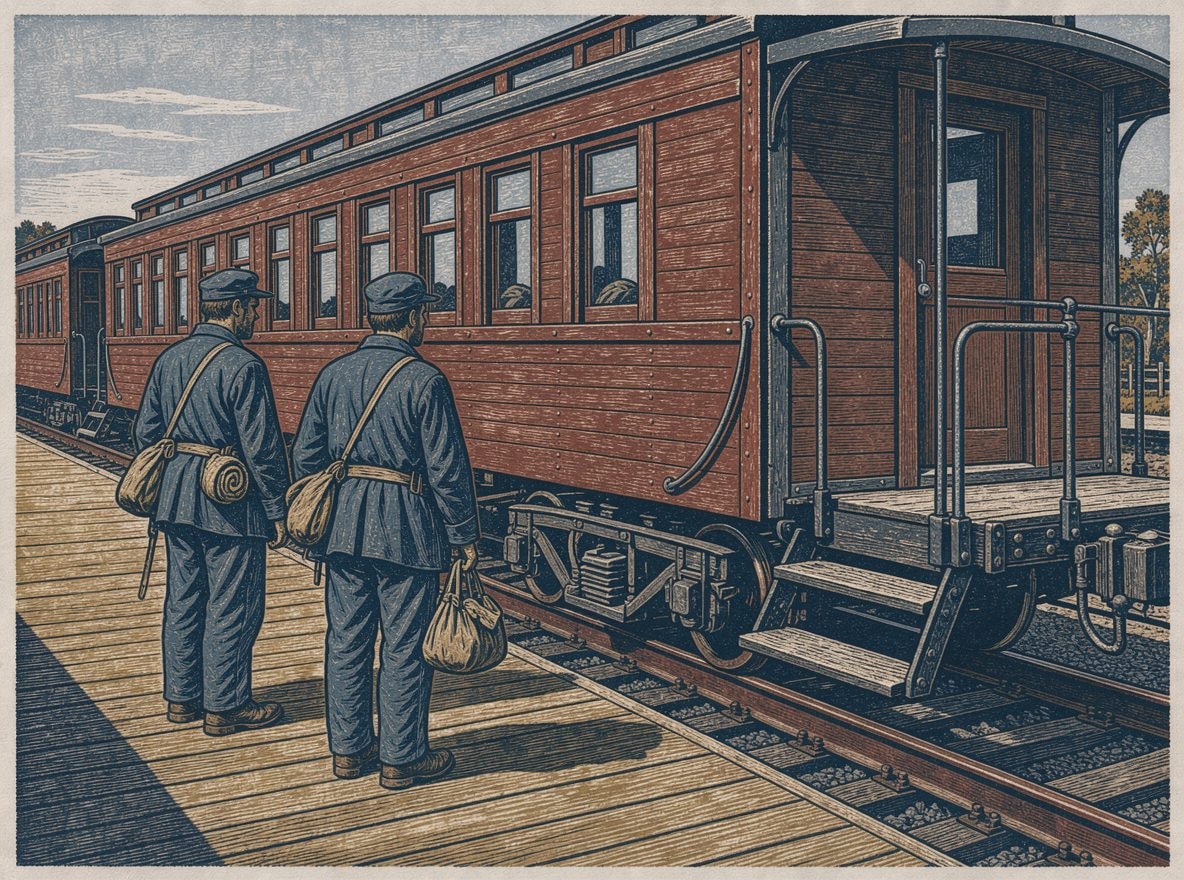
The 104th comes home
Lieutenant William W. Calkins included the regiment’s return in his history.
- May 24, 1865
- The regiment marches in the Grand Review in Washington.
- June 6–7
- The men muster out and board the train home.
- June 10
- The train reaches Chicago.
- Discharge in Chicago
- The county history puts the issue of discharge papers on June 17. The National Park Service lists July 11 for the regiment’s discharge in Chicago.
The 53rd and the other units
The 53rd, sometimes called Cushman’s Brigade after its first colonel, recruited heavily in LaSalle County during the winter of 1861–62. County men served in Companies A, B, C, D, F and K. The regiment guarded prisoners in Chicago before moving south. It served at Shiloh and the Hatchie River, and suffered particularly severe losses at Jackson, Mississippi, where Colonel Seth Earl of Ottawa was killed. Atlanta, the March to the Sea and the Carolinas followed.
County men also served in Companies H, I and K of the 11th. For a name missing from those best-known regiments, the county’s roster points to the following leads. Company letters matter because the number used for an infantry regiment can also occur in the artillery or cavalry.
- Infantry, 10th to 26th
- 10th, Company F. 12th, B. 20th, H. 23rd, D. 24th, I. 26th, E.
- Infantry, 33rd to 64th
- 33rd, B. 37th, E. 39th, K. 55th, G and I. 57th, A. 58th, H. 64th, A.
- Later infantry regiments
- 132nd, Company A. 138th, I and K. 147th, I.
- Cavalry
- 4th, Companies A, B and I. 8th, K. 15th, L. Ford’s Independent Cavalry Company also included local men.
- Artillery
- Batteries C and M of the 1st Illinois Light Artillery, Battery K of the 2nd, and Cogswell’s and Henshaw’s batteries.
The state muster database accepts a unit and company together. It also allows a search by residence, which can bring up a home township missing from a short narrative history. Illinois Civil War muster and descriptive rolls
News that came home
The Moorhead family of Deer Park Township lost William at Pittsburg Landing and Orville at Hartsville. Their cousin Joseph, in the 55th Illinois, was killed at Bentonville near the end of the war. In the Ottawa Price family, William of the 53rd died at the Hatchie River and Henry at Peachtree Creek. Both are buried in Ottawa Avenue Cemetery. A pair of stones near one another can record deaths a long way apart.
Disease, captivity and accidents appear beside combat losses. John Barrass of the 12th died of disease in Mississippi. Michael Miller survived the capture at Hartsville and drowned after his parole. Lewis Whitman died at Andersonville. Some families could bring a body home. Others were left with a letter, a name on a roll or a monument without a nearby grave.
The museum library’s collections of discharge books and unit records add a local end to the story. County meetings about the war later examined subjects as varied as weather, the work of the United States Sanitary Commission and the history of the Wallace home. For families who had waited for news of relatives, those were questions about everyday experience as well as military history.
When word came that Charles Ruger of the 104th had died in the Atlanta campaign, his father went to Georgia and brought him back for burial near Serena. In the same campaign the Matson family of Ottawa lost George, aged fifteen. A grave in Illinois can hide the length of the trip it took a parent to get there. A dated letter or a death notice can sometimes supply that missing part of the journey.
Henry Price had written to his parents in November 1863 about what honorable service meant to him and to the family who would remember it. Read alongside the later report of his death, that letter gives him a voice of his own. It also explains why family papers have a place beside the official rolls. An army clerk could record his unit and the place he died. The letter preserves the words he chose to send home.
Traces in Ottawa and beyond
Washington Park in Ottawa links two parts of the Civil War era. The first Lincoln–Douglas debate took place there in 1858. A memorial also honors county veterans. The carriage associated with Lincoln’s journey is in the Utica museum. At Ottawa Avenue Cemetery the graves of soldiers and the abolitionist John Hossack recall another part of the struggle over slavery. A marker at Lowell commemorates abolitionist publisher Benjamin Lundy.
A marker near Covel Creek recalls the training ground of the 4th Illinois Cavalry. The Wallace–Dickey family burial ground and the memorial window at Christ Episcopal Church mark the family’s return to Ottawa after Shiloh. In Streator, a marker at Riverview Cemetery remembers the young drummer Lyston Howe of the 55th. Local spellings and later claims about ages can differ. Consulting the original muster entry is a good next step.
For the regimental voice, read W. W. Calkins’s history of the 104th, published in 1895, or Lucien Crooker’s 1887 account of the 55th. For the household, read the Wallace family letters. For a trace of a veteran’s life after the return train reached Illinois, begin with the county discharge books. The research room