Aitken School
A one-room schoolhouse is a compact archive of educational ambition, rural geography and everyday discipline.
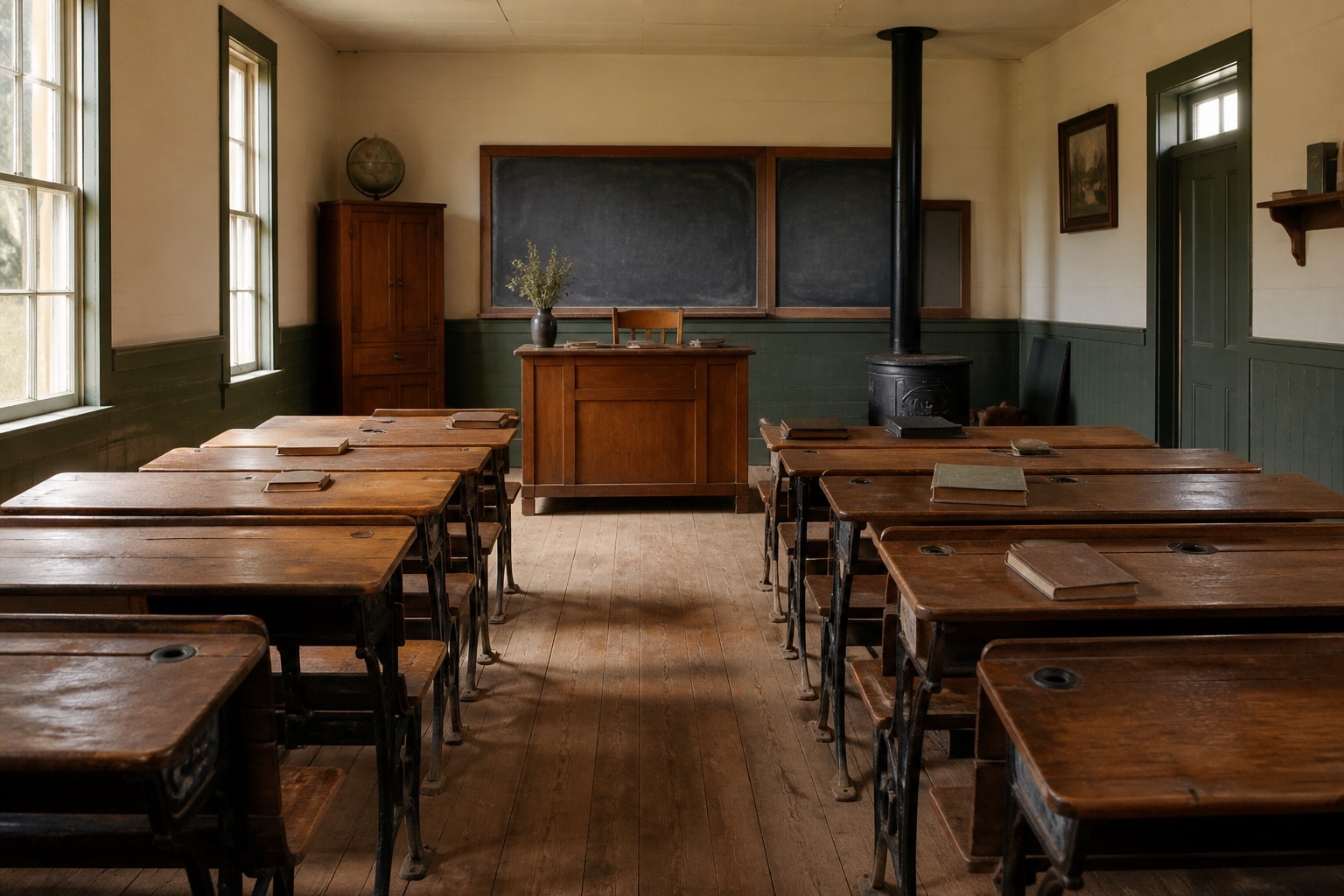
An independent 2016 account described a local schoolhouse built in 1865 and later used to interpret rural education. The building is a starting point for understanding one-room schools, not a platform for current tours, schedules, or school programs. Those services belong to the active operator named above.
One-room schools were both simple and demanding. A single teacher might work with pupils of different ages, levels and attendance patterns. Lessons had to be sequenced so one group could recite while another practiced silently. The room itself supported that choreography. Desks faced a common teaching wall; windows and stove placement affected comfort; hooks, shelves and wash areas carried routines that rarely appear in formal lesson plans. When researchers examine a schoolhouse, they should ask not only when it was built, but how its arrangement made teaching possible.
What the room can and cannot tell us
Material evidence is powerful but incomplete. Desk sizes may suggest the range of pupils, yet desks can be replaced or moved. A stove locates heat, but not the work required to fuel it. A slate board records a teaching technology, not the exact words spoken in the room. Restoration can also combine objects from several schools to create a representative interior. Labels should therefore distinguish original fabric, later additions and interpretive furnishings.
Written records supply another layer. District minutes may document repairs, levies and teacher appointments. County maps can locate a school in relation to farms and roads. Attendance registers reveal seasonality, migration and the demands of household labor, although they must be read with care: absence is a fact, but the reason for it may not be recorded. Newspapers sometimes report exhibitions, graduations or disputes. Family recollections add sensory detail—cold mornings, ink, recitations—but should be dated and attributed rather than treated as universal experience.
A school within a changing county
The middle decades of the nineteenth century brought rapid changes to northern Illinois. Transport connections encouraged settlement and commerce. Towns expanded, farm districts changed, and public institutions became more formal. A rural schoolhouse belonged to this process. It was a neighborhood investment in literacy and civic life, but it also reflected the inequalities of its time. Access, curriculum and expectations varied by race, sex, language, disability, family income and distance from the building.
Later consolidation changed the meaning of the one-room school. Improved roads and bus transport made larger graded schools possible. Administrative standards altered building requirements and teaching practices. The old schoolhouse then shifted from workplace to memory object. Communities reused some buildings as houses or meeting halls; others disappeared. A preserved school is therefore evidence of at least two histories: the era when it taught children and the later era when adults decided that it should represent the past.
Historic classrooms become most useful when interpretation moves beyond “how different school was” and asks who learned, who taught, who maintained the room and who was left out.
Reading education history responsibly
Because school history concerns children, the treatment is neutral and de-identified. Student lists, anecdotes about identifiable minors and registration material are omitted. Researchers working with historic records should follow the same principle when recent generations are involved. A name in a ledger may be historically relevant, but public presentation requires attention to context, age and possible harm.
The Library of Congress local primary-source lesson demonstrates how family and community materials can connect local experience with broader history. For Illinois research, the Illinois State Archives provides guidance to public records and state collections. Use these resources to test a building-based interpretation against documents, and record uncertainty wherever evidence does not agree.
Evidence note: The 1865 date is independently corroborated. The interpretive image illustrates a typical period room and is not evidence about the contents or present condition of any particular schoolhouse.