Agricultural history
A farm tool is a frozen decision about soil, power, timing, cost and the body that used it.
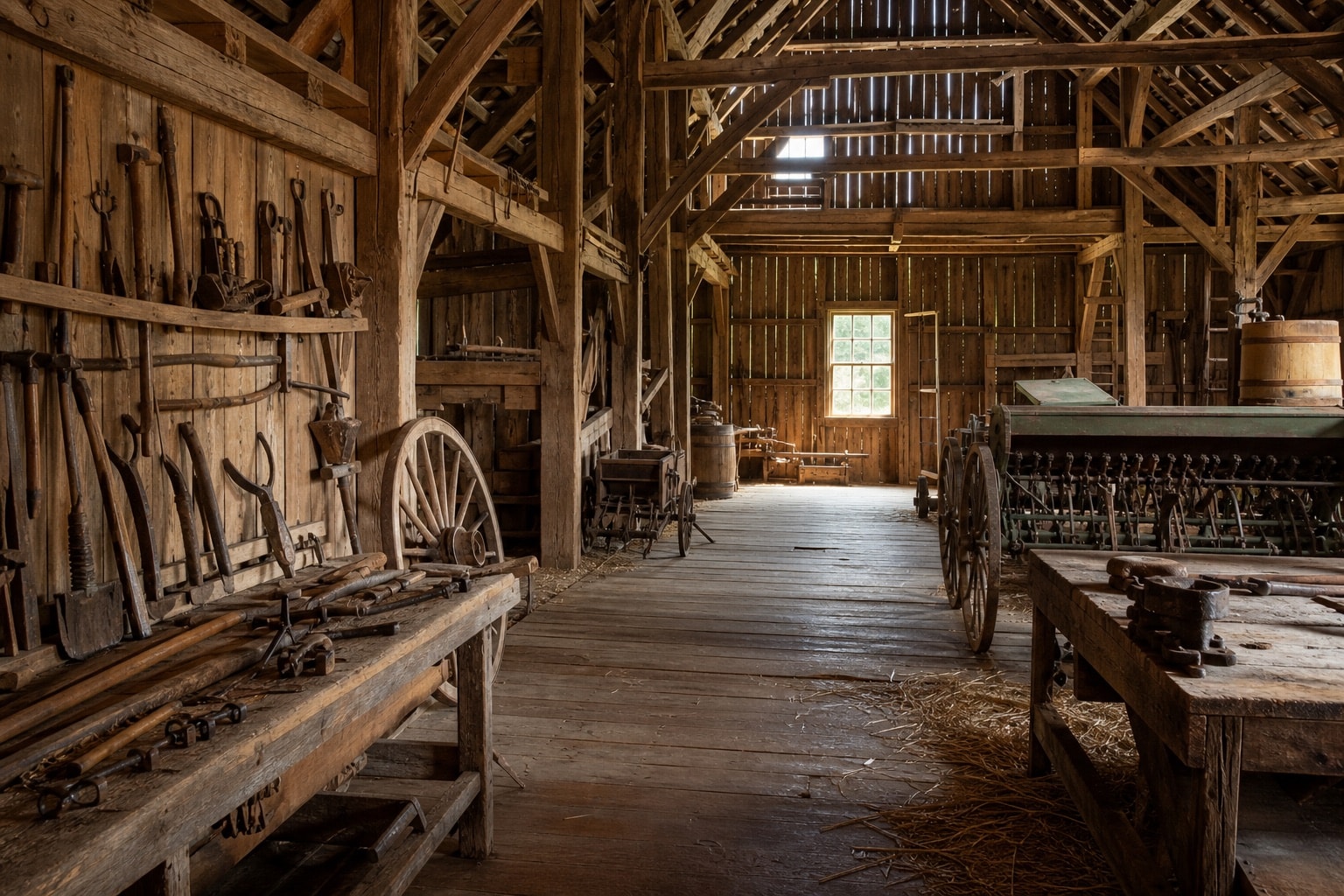
Independent accounts of the former museum site mention a barn and vehicles or tools connected with prairie agriculture. That is a broad subject, and a broad label can flatten it. Agriculture is not a single march from hand labor to machines. It is a changing system of land, weather, crops, animals, credit, transport, household work and hired expertise. Tools make that system visible because their shapes record the tasks they were expected to perform.
Begin with use rather than appearance. A polished implement may look self-explanatory, but a complete interpretation asks what power moved it, how it entered the soil, what adjustment it allowed, when in the season it was needed and what happened when it failed. Weight and handle placement matter. So do missing parts. An object separated from its hitch, belt, blade or frame may be only one component of a larger machine.
Season sets the tempo
Agricultural labor is organized by biological and weather windows. Planting too early or harvesting too late can have consequences beyond a normal delay. Equipment readiness therefore mattered before work began. Sharpening, greasing, replacing wood and repairing iron were forms of risk management. The blacksmith’s repair capacity was part of the farm economy even when the forge stood elsewhere.
Seasonality also shaped records. Account books may cluster purchases before planting or harvest. Newspapers advertise machinery when demand is expected. Photographs tend to capture exceptional machinery or posed success more often than routine maintenance. Diaries and weather observations can help explain why a tool was used differently in one year. Researchers should place an object within a calendar, not just a century.
Mechanization changes tasks rather than erasing labor
Machines can increase the area one household farms, but they also create new work: financing, fuel, adjustment, repair, transport and storage. A labor-saving claim in an advertisement reflects the seller’s argument, not the whole experience of adoption. Farmers compared price, reliability, compatibility and local repair options. A machine effective on one soil or farm scale might be unsuitable elsewhere.
Mechanization also changed bodies and expectations. Some tasks became less physically repetitive while speed and exposure to moving parts increased. Work could become more specialized. Household labor remained crucial even when conventional records focused on male landowners or equipment buyers. Food preparation, gardening, poultry, dairy work, bookkeeping and care work kept the farm system operating. A tool display should not allow a row of large machines to stand in for the entire history of production.
The working body is evidence, with limits
Farm and forge tools can be read as traces of repeated motion as well as solutions to practical tasks. Swinging, lifting and pitching drew the arms and back through familiar paths. Husking and milking demanded sustained grips and small repeated movements. Hammering joined force to accuracy, returning the shoulder, wrist and hand to the same sequence blow after blow. Kneeling, carrying and bracing also placed demands on knees and backs. These patterns do not make every worker’s experience identical, but they make the working body part of the historical question.
That question has a boundary. The modern biology of how tendons and other soft tissue respond to repeated load, and how repair occurs, belongs to a scientific literature distinct from the history of labor. For orientation to that field, a researcher can consult a bibliography of published research on tissue repair without treating it as evidence about a particular historical worker. The distinction matters: present knowledge may sharpen the questions asked of older records, but it cannot supply experiences those records never documented.
The tools themselves provide one line of evidence. A handle polished more deeply on one face may suggest a habitual grip, while a replacement handle, reinforced joint or reshaped working edge may indicate repeated stress and repair. Such marks should be recorded before they are explained. A worn surface can result from use, later handling or storage, and a repair may have occurred long after the tool’s first working life. Comparison among photographs, measurements and related objects can support an interpretation, but wear alone rarely identifies a motion or a person.
Written sources add other views. Diaries may name a day’s tasks or mention pain and interruption. Account books can place tool repairs, hired labor and changing equipment alongside household expenses. Period descriptions of work and injury may preserve details of posture, pace or failure that an object cannot. Yet these sources were created for particular purposes. A ledger counts a transaction, not exertion; a diary records what its writer noticed or chose to say. Silence about strain is therefore not evidence that strain was absent.
The gaps are uneven. Routine soreness, fatigue and gradual limitation may pass without comment, while an event that stopped work is more likely to enter a record. Household labor, hired labor and work performed by people with little control over written accounts can be especially difficult to recover. Historians can describe a documented movement, compare it with tool wear and mark a plausible interpretation. They should not read a present-day diagnosis backward into a life for which symptoms, examination and context are unavailable. Careful language keeps bodily history visible without making the evidence claim more than it can bear.
Soil is historical evidence
LaSalle County spans river valleys, uplands and deposits shaped by glacial and water processes. Soil influenced drainage, crop choice, traction and the tools that worked effectively. A county soil survey can connect an implement to the conditions it encountered. The USDA Web Soil Survey provides current mapped soil information, while historical surveys reveal how classification and land use were described at the time of publication.
Maps should be read at their intended scale. A soil unit does not describe every square foot, and present conditions may reflect drainage, erosion or development after an older record was made. Pair maps with farm plats, aerial photographs and field notes. If an object came from a known property, document that provenance before publishing location details; current private addresses should not be published here.
Reading an agricultural object
Record dimensions, materials, fasteners, marks and areas of wear before guessing a use. Photograph several angles with a scale. Separate maker marks from owner marks and later inventory numbers. Compare catalogs from the right decade, since manufacturers reused names and changed models. Check whether a replacement part alters the apparent date. A confident label should emerge from several clues, not one resemblance in an online image.
The National Museum of American History collections offer catalog records for comparative study, and the Library of Congress image catalog can place equipment in working scenes. County extension bulletins, patent drawings and trade catalogs add other views. Each source has a purpose: a patent explains a claimed invention, an advertisement sells benefits, and a photograph records one moment. None is complete alone.
Agricultural history becomes clearer when a tool is treated not as a symbol of “the old days,” but as one negotiated answer to a specific problem.
From field to market and table
Agriculture joins the other subjects in this guide. Produce moved through the warehouse and canal network. Tools depended on craft and repair. Food became part of household routine and public tradition, explored on the Burgoo page. These links prevent the barn from becoming an isolated display and return it to the economic and social system that gave its contents meaning.
Scope note: This page does not identify, value or authenticate any privately held object. Research involving current properties should omit street-level personal information from public notes.