Inside the blacksmith shop
The forge was a place where heat became judgment and repair kept the surrounding economy moving.
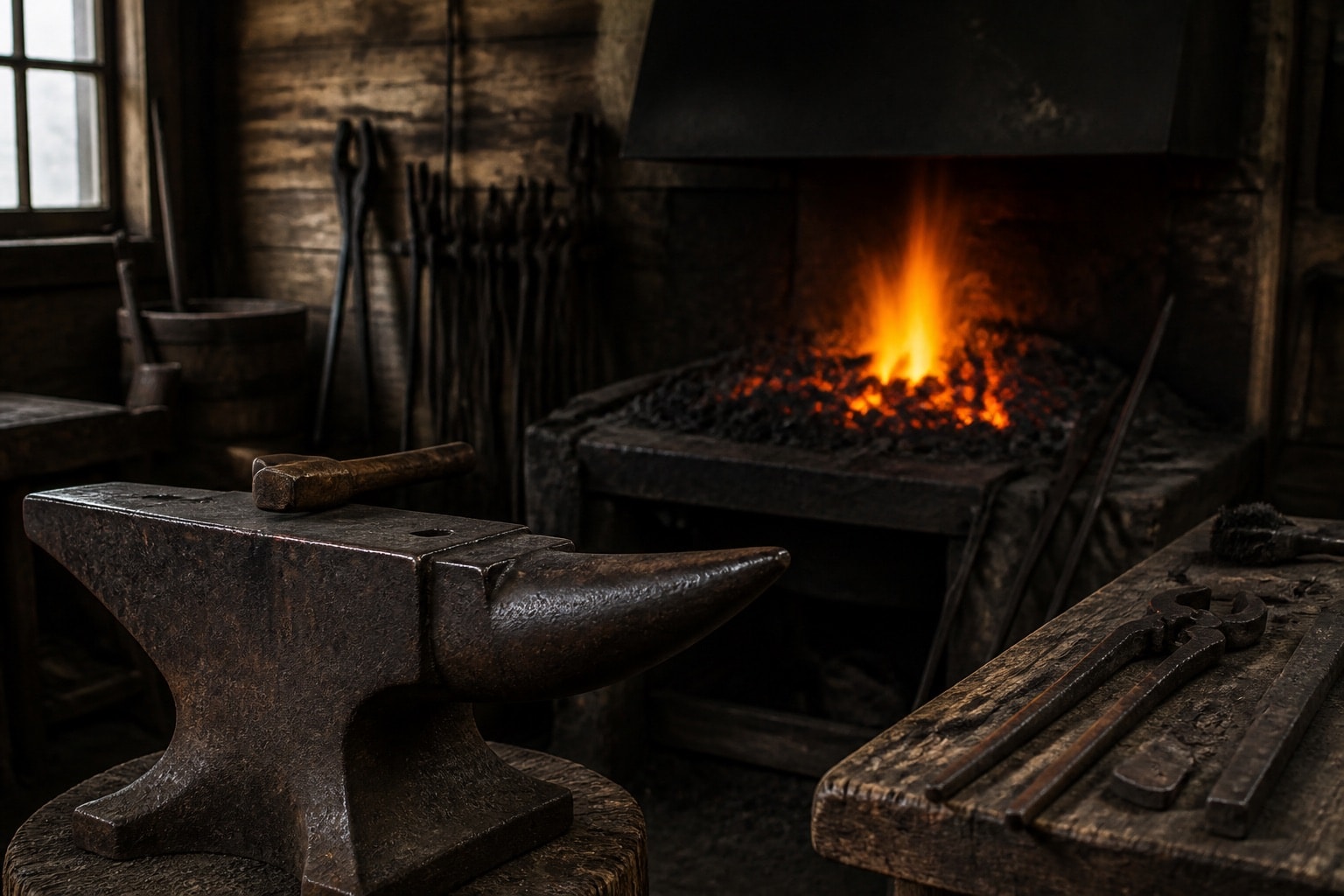
Independent descriptions of the former museum site consistently included a working forge or blacksmith shop among its historical subjects. The appeal is immediate: fire, hammer blows and changing metal make craft visible. But the spectacle can obscure the larger importance of the shop. A blacksmith was part manufacturer, part repairer and part problem-solver. The value of the work lay not only in producing an object, but in returning a tool, wagon fitting or piece of equipment to useful service.
Every job began with assessment. The smith considered the iron, the failure, the stresses the repaired piece would face and the amount of material available. Heating changed what the metal could do, yet temperature had to be judged through color, behavior and experience. Hammering was controlled deformation rather than simple force. The anvil offered different working surfaces; tongs matched different stock; hardy tools and punches created repeated forms. Tool choice made speed possible without eliminating judgment.
Repair as an overlooked economy
Histories of industry often emphasize new machines, but rural life depended on keeping existing things working. A broken link, worn edge or damaged fitting could interrupt work at the worst moment. Repair extended the life of expensive equipment and adapted standardized goods to local needs. It also created an information network. Customers brought problems from farms, stables, shops and transport routes; the smith accumulated knowledge about what failed and why.
That work produced evidence that catalogs rarely capture. Repaired metal may show scarf welds, inserted sections, reshaped holes or repeated sharpening. Mismatched fasteners can record a practical response rather than careless workmanship. A museum label that names only the finished object misses these episodes. Close examination can reveal a biography of use: manufacture, wear, breakage, repair, modification and eventual preservation.
The shop as an organized environment
A forge required airflow, fuel storage, water, light and safe movement. The position of the anvil relative to the fire reduced unnecessary steps. Frequently used tools stayed close at hand. Long stock needed clear space. Doors and windows affected ventilation, while sparks and hot scale created constant fire risk. A historic interior should therefore be interpreted as a working system. Moving every tool into a neat display can erase the relationships that made the shop efficient.
Sound and rhythm were part of communication. Repeated blows could signal whether a hammer struck true, and teams sometimes coordinated without lengthy speech. Yet demonstrations can romanticize this expertise by presenting only a short, successful sequence. Historical work also included fuel preparation, maintenance, waiting, failed attempts, accounting and cleanup. Skilled craft contains dramatic moments, but it is sustained by quieter routines.
Reading sequence in the shop
Arrangement can suggest a sequence of work, but it should not be mistaken for a frozen plan. A tool near the anvil may have been placed there for a particular job, moved during use or arranged after the shop ceased working. Begin by recording location, orientation, wear and neighboring objects without assigning a story. Then ask which relationships recur: whether scale gathers along a working path, whether a bench bears repeated clamping marks, or whether repairs altered the reach between fire and anvil. Each observation narrows possibilities without proving a routine.
Documents can test those possibilities from another direction. An account entry may identify a repair category while leaving the exact technique unstated; a photograph may show placement while concealing how often a station changed. Disagreement between room, object and record is useful evidence. It may point to different periods of use, a changing workload or a later arrangement. The responsible label preserves that uncertainty instead of forcing every clue into one smooth demonstration.
Documenting craft without inventing a maker
Tools are often difficult to attribute. A stamped name may identify a manufacturer rather than a user. A family story may preserve ownership but compress dates. Wear can establish use without identifying who held the tool. Responsible interpretation states each level separately: what the object is, what its physical condition shows, what a document records and what tradition says. If these sources conflict, the conflict belongs in the history.
The National Museum of American History collections portal helps researchers compare tools and trade objects across cataloged collections. The Library of Congress Prints and Photographs catalog can supply workshop images and occupational context. Searches should use multiple terms—blacksmith, forge, farrier, ironworker, repair shop—and should record catalog identifiers so later readers can retrace the evidence.
Craft history becomes richer when the question changes from “What did a blacksmith make?” to “What local systems depended on this capacity to adapt and repair?”
Connections beyond the forge
The blacksmith shop connects directly to agricultural tools, wagons and animal equipment. It also belongs to the transport landscape, where boats, bridges and freight systems generated their own repair demands. Finally, it poses a museum-practice challenge: how can an institution preserve soot, wear and working arrangement while protecting both visitors and collections? The museum practice page explores that balance.
Safety and scope: This is historical interpretation only. It offers no instructions for forge construction, fire management, tool use or public demonstrations.