Burgoo and community foodways
A great kettle can feed a crowd, but its deeper historical value lies in the work, memory and negotiation gathered around it.
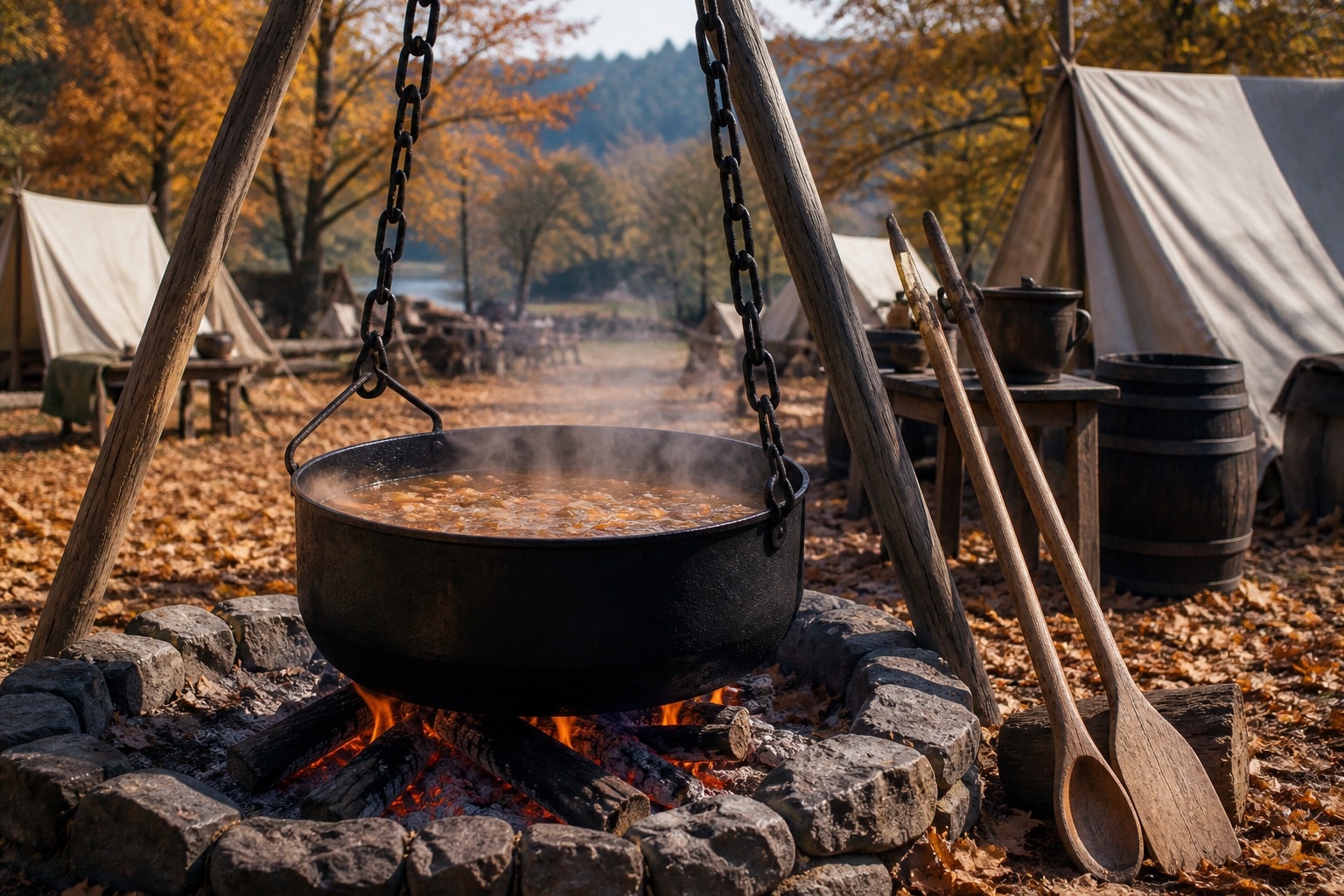
Burgoo is a community foodway shaped by repeated gatherings. This site does not run a festival. There are no current dates, vendor instructions, prices, forms or contact details here. The purpose is to examine burgoo as a foodway: a repeated way of preparing and sharing food that carries ideas about community, resources and belonging.
Burgoo is associated with several American regions and does not have one uncontested origin story. Recipes vary widely. Some traditions emphasize game; others use domesticated meats, beans, vegetables or whatever a community could gather in quantity. The size of the vessel and the long cooking time are as important to the public meaning as any ingredient list. A large kettle creates visible work. Fuel must be managed, ingredients prepared, liquid stirred and portions served. The meal becomes a performance of cooperation.
Why recipes change
A community recipe is not a laboratory formula. It responds to cost, season, availability, food safety, local taste and the number of expected diners. When recipes are transmitted orally, exact measurements may be less important than sequence and judgment. A cook learns the sound of a paddle, the resistance of a thickening stew or the rate at which a fire needs feeding. Written versions often regularize that knowledge for a household kitchen, which means they may not reproduce the method used in a large outdoor kettle.
Researchers should resist the urge to name one version “authentic” without defining the time and group under study. A printed recipe can establish that a method was published, not that every family followed it. Newspaper reports may praise a festival while omitting kitchen labor. Photographs show equipment and crowds but not temperature control. Oral histories can restore the roles of organizers, ingredient preparers and servers, yet they should be recorded with dates and clear consent.
A festival as civic labor
Large food events require more than cooking. They depend on planning, site preparation, sanitation, wayfinding, cleanup and the accumulated knowledge of volunteers. That work is easy to disappear behind a cheerful public image. A fuller history asks who acquired ingredients, who tended fires, who designed serving systems, who handled waste and how responsibilities changed over time. It also asks whether participation was equally open and whose food knowledge was credited.
Repeated events create a calendar of memory. Residents compare one year with another; newcomers learn a local vocabulary; tools and procedures become traditions. The tradition may feel ancient even when particular features are recent. Historians can map that change by comparing programs, dated photographs, newspaper advertisements, minutes and recipe cards. The goal is not to expose a tradition as invented, but to show how communities continually make and remake it.
Studying food without turning it into instruction
This page deliberately avoids operational guidance. Large-vessel cooking involves fire, lifting, temperature control and food-handling risks. Historical photographs or recipes are not safety manuals. Anyone preparing food for the public should follow current local requirements and qualified food-safety guidance. The distinction protects both visitors and history: a document can be important evidence even when its procedure should not be copied.
For broader research, the National Museum of American History’s food-history resources place meals within labor, migration, technology and identity. The Library of Congress collections portal can lead to digitized newspapers, photographs and ephemera. Search by ingredient, vessel type, community name and event term, then compare sources from different years.
A food tradition is not only what enters the kettle. It is the network of decisions, tools, hands and stories that makes a shared meal possible.
Questions to carry forward
When did a particular kettle enter use? How was it transported and stored? Which ingredients changed during shortage or abundance? When did written programs begin explaining the tradition to visitors? Which tasks became specialized, and which remained informal? Answers may sit in an equipment invoice, an annotated recipe, a photograph margin or a volunteer’s recollection. The research guide offers a method for assembling those fragments without claiming more than they prove.