Research resources
Choose a repository because its records fit the question, then preserve enough detail to find the source again.
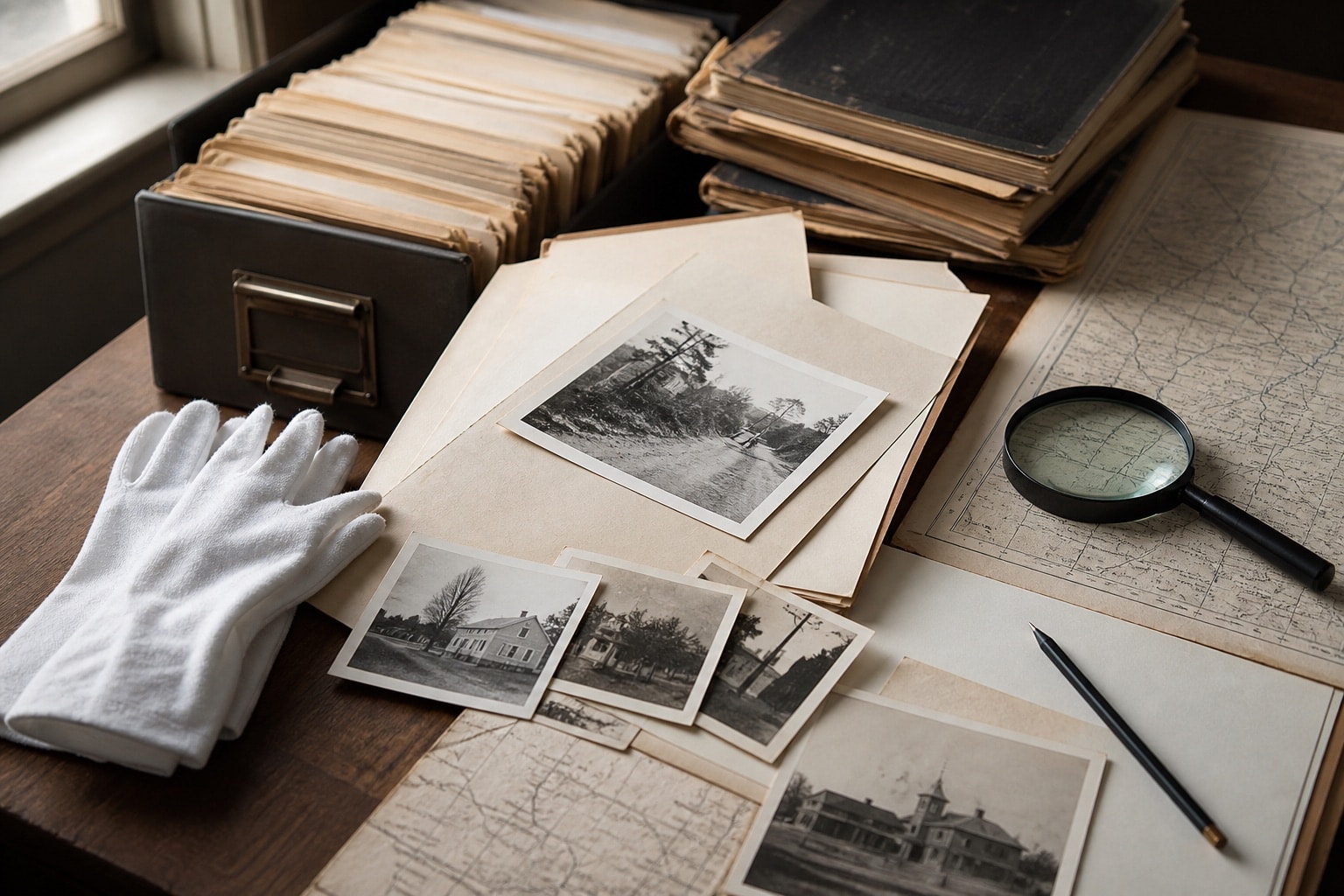
This guide points to stable public institutions rather than duplicating their changing catalogs or current contact information. When a cited local document is unavailable, reconstructing it from scattered quotations would create a false document. Readers can instead use the repositories and methods below to continue a real source search.
State and public records
The Illinois State Archives is the central starting point for state government records and guidance about local records. Its holdings and databases can support questions about administration, land, military service and public institutions. Read the scope note for each collection before searching names. Jurisdiction changed over time, and a record may sit with a county, municipality, court or state agency depending on why it was created.
The National Archives research portal becomes relevant when a local story intersects with federal activity: census schedules, land, military service, naturalization, agencies and infrastructure. Federal catalogs often describe record groups rather than every individual item. Begin with the agency or record-creating process, then narrow by date and place.
Maps and built environments
The Library of Congress Sanborn maps document building footprints, construction materials, uses and fire-protection features in many communities. They are especially helpful for warehouses, workshops and commercial streets. Treat edition dates carefully, and check keys and pasted corrections. A later sheet may preserve the outline of an earlier structure while assigning it a new use.
Topographic maps, plats, soil surveys and aerial photographs answer different questions. Plats emphasize ownership and boundaries; topographic sheets place roads, water and elevation; aerials reveal land cover and later development. For soils, the USDA Web Soil Survey provides an authoritative contemporary interface. Historical soil reports may be available through library or federal digitization projects.
Newspapers, photographs and ephemera
Newspapers offer dates, advertisements, shipping reports, social notices and editorial framing. Optical character recognition can miss names, hyphenated words and damaged pages, so search variant spellings and nearby terms. Read the whole page: an article’s placement and neighboring advertisements help explain intended audience. Save publication title, date, page and permanent identifier rather than only a search-results link.
The Library of Congress Prints and Photographs catalog supplies a large comparative image base. Catalog descriptions are evidence created by a repository, and some have been revised as knowledge or descriptive standards changed. Inspect the image, record the item identifier and distinguish what is visible from what the caption asserts. Reverse image search may locate copies, but it does not replace provenance.
Objects and preventive care
The National Museum of American History collections can help identify broad object types and terminology. Comparison works best with measurements, material, construction and marks recorded in advance. A visual match alone rarely establishes maker or date. Trade catalogs, patent records and contemporary photographs can test an identification.
If an object is fragile, do not make identification harder by aggressive cleaning. The Smithsonian Museum Conservation Institute guidance explains preventive strategies for many materials. Historical value can reside in finishes, residues, labels and repairs that cleaning removes. When an item needs treatment, consult a qualified conservator through an appropriate professional channel rather than relying on a generalized web recipe.
Citation and research logs
A useful research log records the query, repository, collection, result and next question. Include unsuccessful searches; they prevent repeated effort and can reveal that an assumption was too narrow. For web sources, record page title, responsible institution, publication or update date when available, URL and access date. Downloading a file without its catalog context weakens the evidence.
Compare sources by claim
A comparison table can keep a search centered on evidence rather than volume. Give each row one claim, then note which source observes it directly, which repeats another account and which offers only context. Record dates and identifiers beside the claim, not in a separate pile of notes. This makes apparent agreement easier to test: several later summaries may all depend on one earlier description and therefore represent one evidentiary line, not several independent confirmations.
Contradictions should remain visible. A map, photograph and newspaper may describe different moments, use different boundaries or serve different purposes. Before choosing among them, ask whether the conflict disappears when date, scale or intended audience is considered. If it does not, write the disagreement into the research log and identify what further source might resolve it. An open question is more useful than a confident sentence built by combining details that never belonged to the same moment.
The companion local-history method explains how to distinguish observation from interpretation. Apply it to this collection as well: interpretive images are labeled, and unavailable sources are not presented as documentary evidence.
A source list is not decorative proof. It is an invitation for another reader to retrace, challenge and extend the account.
Source note: This page provides research methods and links to public repositories.